Welcome to Khalid Nehar Al Shamry Trading Est. |
[email protected]






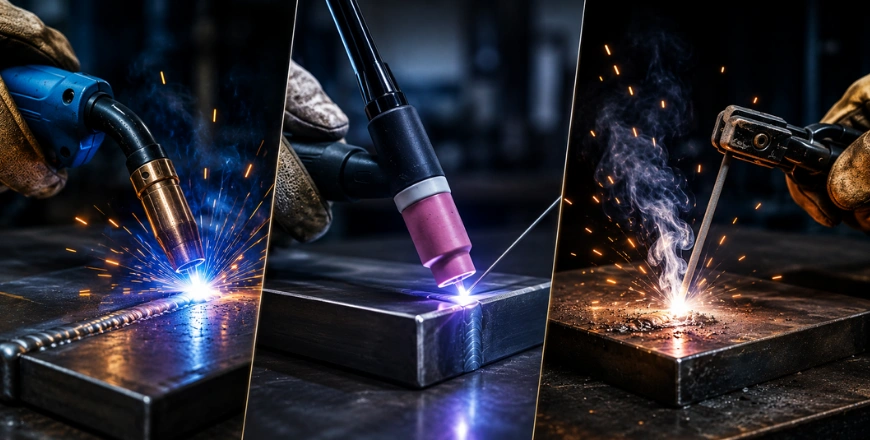
Choosing the right welding process is one of the most important decisions for any welding project. Whether you are a beginner learning welding, a professional fabricator, or an industrial business owner, understanding the differences between MIG, TIG, and ARC welding can help you save time, reduce costs, and produce better-quality welds. Each welding method has its own strengths and limitations. Some are ideal for beginners, while others are better suited for precision work or heavy-duty industrial applications.
In this complete guide, you'll learn:
What MIG, TIG, and ARC welding are
Their advantages and disadvantages
Where each welding process is used
Cost comparison
Which welding method is best for different industries
Frequently Asked Questions
Let's get started.
MIG (Metal Inert Gas) welding, also known as Gas Metal Arc Welding (GMAW), uses a continuously fed wire electrode and shielding gas to create clean, strong welds. The wire automatically feeds through the welding gun, making MIG welding one of the easiest welding methods to learn.
During MIG welding:
A wire electrode continuously feeds through the welding gun.
Electricity creates an arc between the wire and the metal.
The arc melts both the wire and the base metal.
Shielding gas protects the weld from contamination.
The result is a clean and smooth weld with minimal slag.
1. Easy to Learn
MIG welding is considered the best method for beginners because of its simplicity.
2. Faster Welding Speed
Since the wire feeds automatically, welders can complete projects much faster.
3. Clean Welds
Very little slag is produced, reducing cleanup time.
4. High Productivity
Perfect for manufacturing industries where speed matters.
5. Suitable for Thin Metals
Excellent for sheet metal and lightweight fabrication.
Requires shielding gas
Less effective outdoors due to wind
Equipment cost is higher
Not ideal for dirty or rusty metals
MIG welding is widely used in:
Automotive manufacturing
Furniture production
Steel fabrication
HVAC industries
Construction
Agricultural equipment
Home workshops
TIG (Tungsten Inert Gas) welding, also called Gas Tungsten Arc Welding (GTAW), uses a non-consumable tungsten electrode to create the weld.
Unlike MIG welding, the filler rod is added manually by the welder.
TIG welding produces extremely clean, precise, and attractive welds.
1. Excellent Weld Quality
Produces the cleanest and strongest welds.
2. Precision
Ideal for detailed fabrication and thin materials.
3, Attractive Finish
Creates beautiful weld beads requiring very little finishing.
4. Works on Many Metals
Suitable for:
Stainless Steel
Aluminum
Copper
Magnesium
Titanium
Nickel alloys
Slower than MIG welding
Requires more skill
Equipment is more expensive
Lower production speed
TIG welding is widely used in:
Aerospace industry
Food processing equipment
Medical equipment
Bicycle manufacturing
Stainless steel fabrication
Aluminum products
Custom automotive fabrication
ARC Welding, commonly known as Stick Welding or Shielded Metal Arc Welding (SMAW), uses a consumable electrode coated with flux. When electricity passes through the electrode, an arc forms and melts both the rod and the base metal.
The flux coating creates shielding gases and slag to protect the weld.
1. The welder manually feeds the coated electrode.
2. The electric arc melts the electrode and the metal.
3. After welding, slag must be removed.
4. Unlike MIG and TIG welding, ARC welding does not require external shielding gas.
1. Low Equipment Cost
ARC welding machines are affordable.
2. Works Outdoors
Wind does not affect welding quality.
3. Portable
Perfect for field work and repair jobs.
4. Welds Rusty Metals
Can weld dirty or slightly rusty materials effectively.
5. Heavy-Duty Applications
Suitable for thick steel and structural welding.
Produces more slag
Requires cleaning after welding
Slower than MIG welding
Weld appearance is not as clean
Harder for beginners
ARC welding is commonly used in:
Building construction
Pipeline installation
Shipbuilding
Steel structures
Heavy equipment repair
Farm equipment maintenance
Industrial fabrication
| Feature | MIG Welding | TIG Welding |
|
||
|
Easy |
|
Moderate | ||
| Welding Speed | Fast | Slow | Medium | ||
| Weld Appearance | Very Good | Excellent | Good | ||
| Equipment Cost | Medium | High | lOW | ||
| Outdoor Use |
|
|
Excellent | ||
| Thin Metal | Excellent | Excellent | Fair | ||
| Thick Metal | Good | Good | Excellent | ||
| Cleanup | Very Low | Very Low | High | ||
| Precision | Good | Excellent | Moderate |
Choose MIG Welding If:
You are a beginner.
You want faster welding.
You work in workshops.
You manufacture products.
You weld thin steel regularly.
Example
An automobile body shop repairing vehicle panels typically uses MIG welding because it is fast, clean, and efficient.
Appearance matters.
You weld aluminium or stainless steel.
Precision is required.
You manufacture food-grade equipment.
Example
A stainless steel kitchen equipment manufacturer prefers TIG welding because of its clean, hygienic welds.
You work outdoors.
You repair heavy machinery.
You build steel structures.
Budget is limited.
Example
A construction company repairing structural steel at a job site often chooses ARC welding because it performs well in windy conditions.
Cost Comparison
Initial machine cost is moderate. Shielding gas and wire add to ongoing expenses, but productivity is high.
Equipment is more expensive, and slower welding increases labor costs. However, it delivers premium-quality results.
Machines and electrodes are inexpensive, making it the most budget-friendly option for many applications.
Industries That Use Each Welding Process
Automotive manufacturing
Sheet metal fabrication
Furniture manufacturing
HVAC
General fabrication
Aerospace
Medical equipment
Food processing
Pharmaceutical equipment
Aluminum fabrication
ARC Welding
Construction
Shipbuilding
Oil & Gas
Mining
Heavy engineering
Infrastructure projects
Regardless of the welding process:
Wear a certified welding helmet.
Use heat-resistant welding gloves.
Wear flame-resistant clothing.
Ensure proper ventilation.
Keep a fire extinguisher nearby.
Inspect cables before welding.
Use appropriate eye and face protection.
1. Which welding method is easiest to learn?
MIG welding is generally the easiest for beginners because of its automatic wire feed and simple operation.
2. Which welding process produces the strongest weld?
When performed correctly, TIG welding often produces the highest-quality, strongest welds, especially for precision applications.
3. Can ARC welding be used outdoors?
Yes. ARC welding is ideal for outdoor work because it does not rely on external shielding gas.
4. Is TIG welding better than MIG welding?
Not necessarily. TIG welding offers better precision and appearance, while MIG welding is faster and more productive.
5. Which welding method is the least expensive?
ARC welding has the lowest equipment and operating costs, making it a popular choice for repairs and construction.
6. Which welding process is best for aluminum?
TIG welding is widely considered the best option for aluminum because it provides excellent control and clean welds.
7. Which welding method is used in automotive manufacturing?
MIG welding is commonly used for vehicle body panels and production work, while TIG welding is often chosen for custom fabrication and performance parts.
There is no single "best" welding process for every situation. The right choice depends on your material, budget, work environment, skill level, and the quality of finish you need.
Choose MIG welding if you need speed, ease of use, and high productivity.
Choose TIG welding if precision, appearance, and premium-quality welds are your priority.
Choose ARC welding if you work outdoors, repair heavy equipment, or need a reliable and cost-effective solution.
By understanding the strengths and limitations of each method, you can select the welding process that delivers the best results for your specific project.