Welcome to Khalid Nehar Al Shamry Trading Est. |
[email protected]






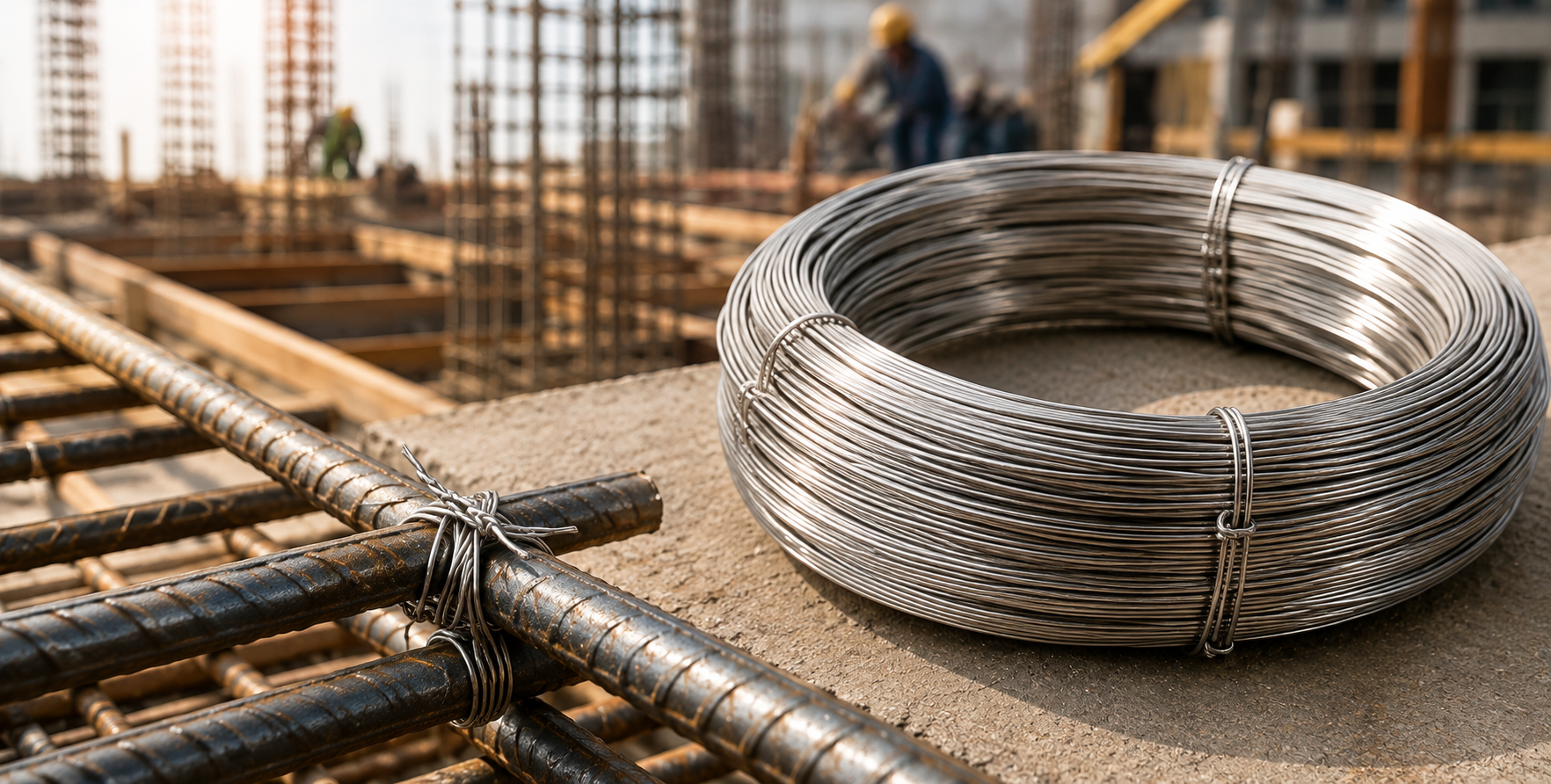
Choosing the right tie wire is important for construction companies, contractors, fabricators, and industrial buyers. Tie wire is commonly used for tying, securing, bundling, and holding materials in place during different construction and industrial activities. However, not every tie wire is the same. The material grade, wire diameter, flexibility, surface condition, packaging, and intended application can all affect which product is suitable for a particular project.
0.5mm Stainless Steel 304 Tie Wire can be considered for applications where a relatively fine wire diameter and stainless steel material are required. Stainless steel 304 is commonly selected for its corrosion resistance and general durability compared with ordinary carbon steel wire. However, the right choice always depends on the specific application and environmental conditions.
For construction companies and industrial buyers in Saudi Arabia, understanding these factors before purchasing can help avoid selecting a wire that does not match the project's requirements. This guide explains what to look for when choosing 0.5mm Stainless Steel 304 Tie Wire and how KASWELD can help businesses source suitable industrial products.
Tie wire is a flexible metal wire used to secure, bind, or hold materials together. It can be used in construction, fabrication, maintenance, bundling, and other industrial applications where a flexible fastening material is required.
The term 0.5mm refers to the approximate diameter of the wire. Wire diameter is an important consideration because it affects how easily the wire can be bent, twisted, handled, and used for a particular application.
Stainless Steel 304 refers to the material grade. Stainless steel 304 is widely used in many applications where corrosion resistance and durability are important considerations.
Compared with ordinary carbon steel binding wire, stainless steel tie wire can offer better resistance to corrosion in many common environments. However, this does not mean that Stainless Steel 304 is suitable for every environment. Applications involving severe chemical exposure, marine conditions, or other highly corrosive environments may require a different material or grade.
Before purchasing, buyers should always confirm the material grade and product specifications with the supplier.
Construction projects can expose materials to moisture, outdoor conditions, dust, and changing environmental conditions. Selecting the right material can therefore be important for long-term performance.
Some practical reasons buyers may consider stainless steel 304 tie wire include:
Corrosion resistance compared with ordinary carbon steel wire
Good durability for suitable tying applications
Flexibility for bending and twisting
Easy handling during installation
Suitability for various general tying and securing applications
Useful performance in many common construction environments
One of the main advantages of stainless steel is its resistance to corrosion. However, actual performance depends on the environment in which the wire is used.
For example, exposure to moisture, chemicals, salt, or other aggressive substances can affect material performance. Buyers should therefore consider the actual working environment instead of assuming that every stainless steel product will perform equally in all conditions.
Wire diameter is an important factor when selecting 0.5mm stainless steel tie wire.
A 0.5mm wire is relatively fine, which can make it suitable for applications where flexibility and ease of handling are important. A finer wire can generally be easier to bend and twist by hand compared with thicker wire, although the required holding performance must always be considered.
When selecting the diameter, consider:
The type of material being tied
The required holding performance
How frequently the wire will be twisted
Ease of handling
Installation method
Project requirements
The correct diameter should be selected based on the application rather than assuming that 0.5mm is suitable for every construction task.
A wire used for light bundling may have different requirements from one used for reinforcement-related tying or fabrication work. Always check the application requirements before purchasing.
The specific use of 0.5mm Stainless Steel 304 Tie Wire depends on the project and required holding performance.
Potential applications include:
1. General Construction Tying
Tie wire can be used to secure and hold materials together during construction activities. The flexibility of fine wire can make it practical for applications involving repeated bending and twisting.
2. Securing Light Materials
Fine stainless steel wire can be considered for securing or bundling suitable lightweight materials where the wire's strength and diameter meet the application requirements.
3. Wire Mesh Applications
Tie wire can be used for certain wire mesh-related securing applications. The appropriate wire should be selected according to the mesh type and required holding performance.
4. Reinforcement-Related Tying
Tie wire is commonly associated with tying reinforcement materials during construction. However, the exact wire diameter and material should be selected according to the project requirements and applicable construction practices.
Tie wire should not automatically be treated as a structural fastener or load-bearing component.
5. Fabrication and Maintenance
Stainless steel tie wire may also be useful in fabrication, maintenance, bundling, and other industrial applications where a flexible wire is required.
The important point is to match the wire to the intended application rather than using the same product for every task.
1. Confirm the Stainless Steel Grade
Before purchasing, verify that the product is actually Stainless Steel 304 if that is what your project requires.
Do not assume that every product described as stainless steel has the same material composition or properties.
Ask the supplier for relevant product information and confirm the grade before placing a large order.
2. Check the Wire Diameter
Confirm that the wire diameter is approximately 0.5mm and that this size is appropriate for the intended application.
For large construction projects, consistent wire dimensions can be important when the product is being used repeatedly across many work areas.
3. Consider Corrosion Resistance
Stainless steel is often selected because of its corrosion resistance compared with ordinary steel.
However, the actual environment matters.
Consider whether the wire will be exposed to:
Moisture
Outdoor conditions
Industrial environments
Chemicals
Salt or coastal conditions
Stainless Steel 304 may be suitable for many general applications, but it should not automatically be considered the best option for every highly corrosive environment. Other stainless steel grades may be considered depending on the exposure conditions.
4. Check Strength and Flexibility
The wire needs to provide an appropriate balance between flexibility and holding performance.
A construction worker may need to bend and twist the wire several times during installation. A wire that is difficult to handle can make the work less convenient, while a wire that does not provide sufficient holding performance may not be appropriate for the application.
Always select the wire according to the requirements of the job.
5. Consider the Surface Finish
The surface condition of the wire can affect handling and general appearance.
Buyers should look for a product with a clean and consistent surface suitable for the intended use. If a particular finish is required, confirm the specification with the supplier before ordering.
Packaging can make a significant difference when purchasing tie wire for construction projects.
Consider:
Coil or spool format
Roll length
Product weight
Packaging method
Storage requirements
Ease of carrying around the construction site
For larger projects, consistent packaging can also make purchasing, storage, and distribution easier.
7. Choose a Reliable Supplier
A reliable supplier should be able to provide clear product information, material details, packaging information, and availability.
This is especially important when purchasing stainless steel tie wire in Saudi Arabia for commercial or industrial projects.
Before ordering, ask for the relevant product specifications and confirm that the product matches your requirements.
| Factor | 0.5mm Stainless Steel 304 Tie Wire | Ordinary Binding Wire |
|---|---|---|
| Material | Stainless Steel 304 | Often carbon steel or other specified material |
| Corrosion Resistance. | Generally better resistance to corrosion | Generally more susceptible to corrosion |
| Durability | Suitable for many demanding tying applications | Depends on material and environment |
| Flexibility | Suitable for bending and twisting | Depends on wire specification |
| Typical Uses | Tying, securing, bundling, selected construction applications | General construction and binding applications |
| Environmental Suitability. | Can be suitable for many environments, depending on exposure | Depends strongly on coating and material |
| Cost | May have a higher purchase cost | May be more economical for some applications |
The best option depends on the project, environmental conditions, application, and budget. A higher-cost stainless steel wire is not automatically the right choice for every construction project.
Step 1: Identify the Application
Determine exactly what the wire will be used for. Is it for tying reinforcement, bundling materials, securing mesh, fabrication, or maintenance?
Step 2: Determine the Required Diameter
Check whether 0.5mm is appropriate for the application and required holding performance.
Step 3: Select the Material Grade
If corrosion resistance is important, determine whether Stainless Steel 304 meets the environmental requirements.
Step 4: Consider Environmental Conditions
Consider moisture, outdoor exposure, chemicals, salt, and other conditions that may affect the wire.
Step 5: Check Strength and Flexibility
Make sure the wire can be handled and twisted as required while providing suitable holding performance.
Step 6: Confirm Surface Finish
Check whether the surface condition and finish meet the project's requirements.
Step 7: Check Packaging
Choose a coil, spool, or roll format that is practical for storage and use.
Step 8: Verify Product Specifications
Confirm material grade, diameter, packaging, and other relevant product information before purchasing.
Step 9: Compare Suppliers
Compare product information, availability, consistency, and supplier support rather than looking only at price.
Step 10: Order According to Project Requirements
For large projects, make sure the quantity, packaging, and product specifications match the project's needs.
Construction buyers should avoid several common purchasing mistakes.
Choosing only based on price: The cheapest wire may not match your required material grade or application.
Not checking the stainless steel grade: Stainless steel products can have different grades and properties.
Assuming every stainless steel wire is the same: Diameter, material, finish, packaging, and manufacturing specifications can differ.
Ignoring wire diameter: A wire that is too fine or too thick may not be appropriate for the intended application.
Ignoring environmental conditions: Moisture, chemicals, and salt exposure should be considered before selecting the material.
Buying inconsistent-quality wire: For large projects, inconsistent diameter or quality can create handling and purchasing problems.
Not checking packaging and roll length: The right product in the wrong packaging may be inconvenient for site operations.
Using tie wire beyond its intended purpose: Tie wire is generally intended for tying and securing. It should not automatically be used as a structural or load-bearing fastener.
Proper storage can help protect the product before use.
Follow these basic practices:
Keep the wire clean and dry.
Protect packaging from moisture and damage.
Store coils in a suitable location.
Avoid unnecessary contamination.
Keep different stainless steel grades properly identified and separated.
Handle coils carefully to prevent damage.
Follow supplier or manufacturer recommendations.
Good storage practices are particularly important on busy construction sites where materials may be moved frequently.
Choosing a reliable stainless steel tie wire supplier in Saudi Arabia can be important for construction companies, contractors, fabricators, and industrial buyers.
KASWELD supplies industrial products, construction-related materials, welding products, safety products, tools, and other industrial supplies for professional customers in Saudi Arabia.
Businesses looking for 0.5mm stainless steel tie wire can contact KASWELD to discuss their application and product requirements. Buyers can provide information such as the required diameter, stainless steel grade, application, environmental conditions, packaging requirements, and quantity.
For construction companies purchasing materials for ongoing projects, confirming product specifications before ordering can help reduce the risk of receiving a product that does not match the project's requirements.
KASWELD can also support customers looking for other industrial and construction-related products as part of their project requirements.
1. What is 0.5mm Stainless Steel 304 Tie Wire?
0.5mm Stainless Steel 304 Tie Wire is a fine stainless steel wire with an approximate diameter of 0.5mm. It can be used for tying, securing, bundling, and other suitable construction or industrial applications. The exact suitability depends on the required holding performance and environmental conditions.
2. What is Stainless Steel 304 Tie Wire used for?
It can be used for suitable tying, securing, bundling, fabrication, maintenance, wire mesh, and selected construction applications. It should be selected according to the requirements of the specific job and should not automatically be treated as a structural or load-bearing fastener.
3. Why choose 0.5mm tie wire for construction?
A 0.5mm wire can be considered where a relatively fine and flexible wire is required. Its smaller diameter can make it convenient for bending and twisting. However, the required holding performance and application should always be considered before selecting the diameter.
4. Is 304 stainless steel tie wire corrosion resistant?
Yes, Stainless Steel 304 is generally selected for its corrosion resistance compared with ordinary carbon steel. However, its performance depends on the environment. Applications involving severe chemical, marine, or highly corrosive exposure may require consideration of another material or stainless steel grade.
5. Is 0.5mm tie wire suitable for every construction application?
No. Wire diameter and material should be selected according to the specific application. Some applications may require a different diameter, material, or fastening method. Buyers should confirm project requirements before choosing 0.5mm stainless steel tie wire.
6. What is the difference between stainless steel tie wire and ordinary binding wire?
The main difference is the material. Stainless steel tie wire offers greater corrosion resistance in many environments compared with ordinary carbon steel wire. Ordinary binding wire may be a more economical option for applications where higher corrosion resistance is not required.
7. How should stainless steel tie wire be stored?
Store it in a clean, dry location and protect it from moisture, contamination, and packaging damage. Keep different grades properly identified and separated. Follow the supplier's storage recommendations for the specific product.
8. Where can I buy stainless steel tie wire in Saudi Arabia?
Construction companies and industrial buyers can contact KASWELD for stainless steel tie wire and other industrial products in Saudi Arabia. Provide the required diameter, grade, application, quantity, and packaging requirements to help identify a suitable product.
Conclusion
Choosing the right 0.5mm Stainless Steel 304 Tie Wire for construction requires consideration of more than just wire diameter. Buyers should evaluate the stainless steel grade, 0.5mm diameter, application, environmental exposure, strength, flexibility, surface condition, packaging, and supplier reliability before purchasing.
Stainless Steel 304 can be a practical option for many applications where corrosion resistance and durability are important considerations. However, the suitability of the material depends on the actual working environment and project requirements.
The 0.5mm diameter can be useful where a relatively fine and flexible wire is required, but it should not automatically be considered suitable for every construction application. Buyers should always confirm the required holding performance and product specifications.
For businesses looking for 0.5mm Stainless Steel 304 Tie Wire in Saudi Arabia, KASWELD can provide industrial and construction-related products based on customer requirements. Contact KASWELD with your application, required grade, diameter, quantity, and packaging needs to discuss a suitable product for your project.