Welcome to Khalid Nehar Al Shamry Trading Est. |
[email protected]






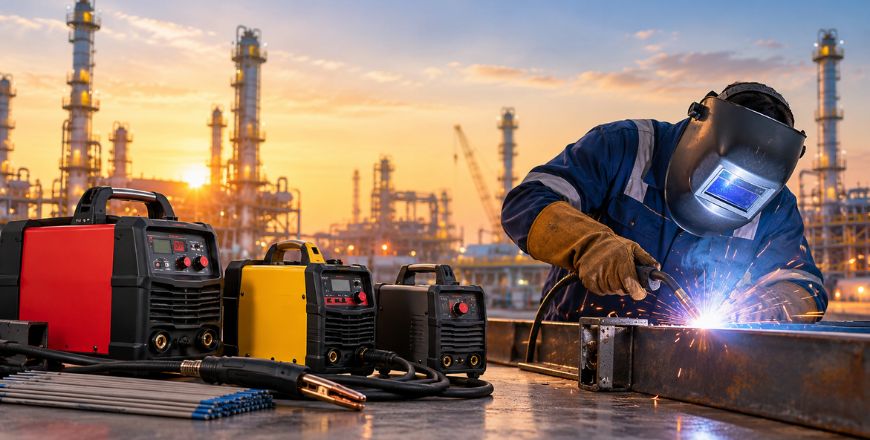
Choosing the right welding machine is an important decision for fabrication workshops, construction companies, maintenance teams, manufacturers, and industrial contractors in Saudi Arabia. The wrong machine can make welding slower, increase consumable use, affect weld quality, and create unnecessary maintenance problems. With different welding processes, power requirements, materials, machine capacities, and working conditions available, it is not always easy to know which machine is suitable for a particular job.
So, how do you choose the right welding machine for industrial applications in Saudi Arabia? The answer depends on several factors, including the type and thickness of metal, welding process, required output current, working environment, duty cycle, available power supply, portability, and the type of work being carried out. This guide explains the main points industrial buyers should consider before purchasing a welding machine and how to select equipment that matches their actual work requirements.
An industrial welding machine is equipment used to generate the electrical power and control required to join metal components through a suitable welding process.
Industrial welding machines are commonly used in:
Metal fabrication
Construction projects
Oil and gas work
Pipeline fabrication and maintenance
Manufacturing
Structural steel work
Equipment repair
Shipbuilding and marine applications
Industrial maintenance
Engineering workshops
The right machine depends on the application. A machine suitable for light fabrication may not be the right choice for continuous heavy-duty welding.
For industrial buyers, the goal should not simply be to select the machine with the highest current rating. The machine should match the material, welding process, workload, site conditions, and available electrical supply.
Before purchasing a welding machine, start by understanding the actual welding requirements. Consider the following factors.
1. Identify the Welding Process
Different welding processes are suitable for different applications. Common options include:
2. Arc Welding
3. MIG Welding
MIG welding, commonly associated with GMAW, uses a continuously fed welding wire and shielding gas.
It can be useful for:
Fabrication workshops
Sheet metal work
Production environments
Structural fabrication
Repetitive welding operations
MIG welding can offer faster wire feeding and reduced electrode replacement compared with traditional stick welding, but the equipment also requires suitable wire, shielding gas, and accessories.
4. TIG Welding
5. FCAW
Flux-cored arc welding uses a continuously fed tubular wire. Depending on the process and consumable, it can be used for fabrication and heavy-duty applications.
The suitable process should always be selected based on the material, welding procedure, site conditions, and project requirements.
2. Check the Material Being Welded
The metal being welded is one of the most important factors when selecting a welding machine.
Common industrial materials include:
Carbon steel
Stainless steel
Aluminium
Low-alloy steel
Cast iron
Nickel alloys
Different materials require different welding procedures and consumables. AWS, for example, publishes separate filler-metal specifications for different materials and welding processes.
Before purchasing a machine, identify:
Material type
Material thickness
Joint design
Required welding position
Welding process
Required filler metal or electrode
Project welding procedure requirements
For example, a workshop that mainly welds carbon-steel structures may have different equipment requirements from a facility working with thin stainless-steel components.
3. Consider the Metal Thickness
4. Check the Duty Cycle
This is especially important for:
Production welding
Structural fabrication
Heavy equipment repair
Pipeline work
Large fabrication workshops
Long welding runs
5. Check the Available Power Supply
The machine must be compatible with the electrical supply available at the workshop or project site.
Before buying, check:
Input voltage
Single-phase or three-phase supply
Frequency
Required input current
Generator compatibility, if applicable
Plug and connection requirements
Industrial electrical requirements can vary between facilities and applications. Do not assume that every welding machine can be connected to the same power source.
For projects in Saudi Arabia, electrical and product compliance requirements should also be checked against the applicable Saudi regulations and standards. SASO maintains technical regulations and product-related conformity requirements that may apply depending on the equipment and product category.
6. Consider Where the Machine Will Be Used
A workshop-based welding machine may have different requirements from equipment used at a construction site.
Ask:
Will the machine stay in one location?
Does it need to be moved frequently?
Is the work indoors or outdoors?
Is a generator being used?
Is there limited access to electrical power?
Will the machine be exposed to dust or difficult site conditions?
Is the machine required for continuous production?
For site work, portability can be important. For a fabrication workshop, output capacity, duty cycle, controls, and ease of maintenance may be more important.
7. Look at Portability and Machine Size
A compact machine may be convenient for maintenance teams and site welders who regularly move between work areas.
Larger industrial machines may be more appropriate for fixed fabrication stations where high output and continuous operation are required.
Before choosing, consider the complete setup—not just the welding power source.
The total working system may include:
Welding machine
Welding torch or electrode holder
Welding cables
Earth/ground clamp
Wire feeder
Gas regulator
Shielding gas equipment
Welding consumables
Protective equipment
8. Consider the Type of Work
The application should guide the purchase.
| Application | Commonly Considered Options | Important Factors |
|---|---|---|
| General fabrication | MIG / Arc | Material, thickness, productivity |
| Structural steel | Arc / MIG / FCAW | Thickness, outdoor conditions, duty cycle |
| Precision welding | TIG | Material, heat control, weld quality |
| Maintenance and repair | Arc / MIG | Portability, material range |
| Sheet metal fabrication | MIG / TIG | Low-current control, material thickness |
| Heavy fabrication | MIG / FCAW / Arc | Output, duty cycle, consumables |
| Stainless-steel work | TIG / MIG | Material, finish, heat control |
This table is a general guide rather than a substitute for a qualified welding procedure or manufacturer's recommendations.
9. Check Machine Controls and Features
A machine with many features is not automatically the best machine.
Choose controls that are useful for your application.
Depending on the equipment, useful features may include:
Adjustable welding current
Voltage control
Wire-feed control
Digital display
Thermal protection
Overload protection
Process selection
Adjustable arc characteristics
Suitable connections for required accessories
The most important point is to understand what your welders actually need.
For a simple repair operation, a basic and reliable machine may be more practical than a complex machine with functions that are rarely used.
10. Consider Consumables and Accessories
The welding machine is only one part of the welding system.
You should also consider the availability and compatibility of:
Electrodes
Welding wire
Tungsten electrodes
Contact tips
Nozzles
Torches
Regulators
Welding cables
Electrode holders
Earth clamps
Gas hoses
A machine may be technically suitable, but regular operation can become difficult if compatible consumables and replacement accessories are difficult to source.
Kasweld's current product categories include arc welding, MIG welding, TIG welding, gas welding, welding consumables, regulators, cutting consumables, welding gloves, and related welding products.
The right machine can help a welding operation work more consistently and efficiently.
1. Better Matching Between Machine and Application
When the welding process, machine output, and consumables match the job, welders can work within an appropriate operating range.
2. Reduced Downtime
A machine selected for the expected workload is less likely to become a bottleneck during production.
3. Easier Consumable Planning
Knowing the welding process in advance makes it easier to plan electrodes, wire, shielding gas, and replacement parts.
4. Better Workplace Planning
The correct machine also helps teams plan electrical connections, cables, ventilation, protective equipment, and work areas.
5. More Practical Procurement
Instead of purchasing equipment based only on price or maximum amperage, procurement teams can compare machines against actual project requirements.
1. Choosing Only by Price
The cheapest machine may not be the most economical option if it cannot handle the workload.
Consider the complete operating requirement, including consumables, accessories, maintenance, and expected working hours.
2. Choosing the Highest Amperage
More amperage does not automatically mean better performance.
A machine should be selected according to the current range normally required for the job.
3. Ignoring Duty Cycle
This can be a major problem in production environments. Always check the duty cycle at the operating current you expect to use.
4. Forgetting the Power Supply
A machine that does not match the available electrical supply may create installation or operational problems.
5. Not Checking Consumable Availability
Before buying, confirm that electrodes, wire, torches, tips, regulators, and other required accessories are available.
6. Buying Without Considering the Work Environment
A workshop, construction site, maintenance vehicle, and industrial plant may have very different equipment requirements.
Use this checklist before requesting a quotation:
What metal will be welded?
What is the minimum and maximum material thickness?
Which welding process is required?
What welding current range is normally needed?
What duty cycle is required?
What electrical supply is available?
Is portability important?
Will the machine be used indoors or outdoors?
Will a generator be used?
Which electrodes or welding wires are required?
Is shielding gas required?
Are compatible accessories available?
Does the equipment meet applicable project and regulatory requirements?
Is after-sales or technical support available?
Can the supplier provide the required technical specifications and documentation?
For regulated projects, always confirm the latest applicable Saudi requirements before procurement rather than relying on a general checklist. SASO provides current technical regulations and conformity-related information through its official channels.
Choosing the supplier is almost as important as choosing the machine.
Look for a supplier that can help you compare equipment according to your application rather than simply recommending the most expensive option.
Ask the supplier for:
Product technical specifications
Input and output requirements
Duty-cycle information
Recommended applications
Compatible consumables
Available accessories
Product documentation
Warranty information
Availability and delivery options
Technical support, where applicable
For industrial projects, procurement teams should provide the supplier with as much information as possible about the application. This allows the supplier to recommend equipment based on actual requirements.
Khalid Nehar Al Shamry Trading Est., operating through Kasweld, is a Saudi-based supplier of welding equipment, accessories, metalworking, tooling, cutting products, and related industrial supplies. The company states that it has been operating since 2000 and serves industrial customers through its product and supply network.
Kasweld lists welding-related categories covering arc welding, MIG welding, TIG welding, gas welding, welding consumables, regulators, cutting consumables, welding gloves, purging products, and other related supplies.
For buyers comparing equipment, the practical approach is to share the material, thickness, welding process, operating environment, power supply, and expected workload with the supplier. This gives the supplier the information needed to identify suitable products and accessories.
1. What is the best welding machine for industrial use?
There is no single welding machine that is best for every industrial application. The right choice depends on the welding process, material, thickness, workload, duty cycle, power supply, and working environment.
2. Which welding machine is suitable for steel fabrication?
Arc, MIG, and flux-cored welding systems can be considered for steel fabrication. The best option depends on material thickness, production volume, welding position, site conditions, and project requirements.
3. Is MIG welding suitable for industrial applications?
Yes. MIG welding can be suitable for many fabrication and production applications, particularly where continuous wire feeding and productivity are important. The correct machine and consumables should be selected for the specific material and application.
4. When should I choose a TIG welding machine?
TIG can be a good choice when precise control and weld quality are important, particularly for applications involving stainless steel, aluminium, or thinner materials. However, the process may be slower than other welding methods.
5. What does welding machine duty cycle mean?
Duty cycle indicates how long a welding machine can operate at a specified output within a defined test period before cooling is required. Always compare duty-cycle ratings at the current you expect to use.
6. How do I know what welding machine amperage I need?
Start with the material type and thickness, welding process, electrode or wire specification, and welding procedure. The required current should then be selected according to the manufacturer's recommendations and applicable weldi0ng procedure.
7. What should I check before buying a welding machine in Saudi Arabia?
Check the welding process, material, thickness, current range, duty cycle, electrical supply, portability, consumables, accessories, documentation, and applicable Saudi requirements.
8. Should I buy the welding machine and consumables from the same supplier?
It can be practical because the supplier can help check compatibility between the machine, torch, cables, electrodes, wire, regulators, and other accessories. However, the products should still be evaluated against the technical requirements of the application.
Choosing the right welding machine for industrial applications in Saudi Arabia requires more than comparing prices or maximum amperage. The machine should match the material, welding process, thickness, duty cycle, electrical supply, working environment, and expected workload. Before placing an order, prepare a clear list of your welding requirements and ask the supplier to provide suitable technical options. Also check consumable availability, accessories, documentation, and any applicable Saudi compliance requirements.
For industrial buyers looking for welding equipment and related supplies in Saudi Arabia, Khalid Nehar Al Shamry Trading Est. (Kasweld) provides a range of welding and industrial product categories for fabrication, construction, maintenance, and other applications.
Need help selecting welding equipment for your industrial application?
Share your material type, thickness, welding process, and project requirements with Khalid Nehar Al Shamry Trading Est. to discuss suitable welding equipment and related accessories.