Welcome to Khalid Nehar Al Shamry Trading Est. |
[email protected]






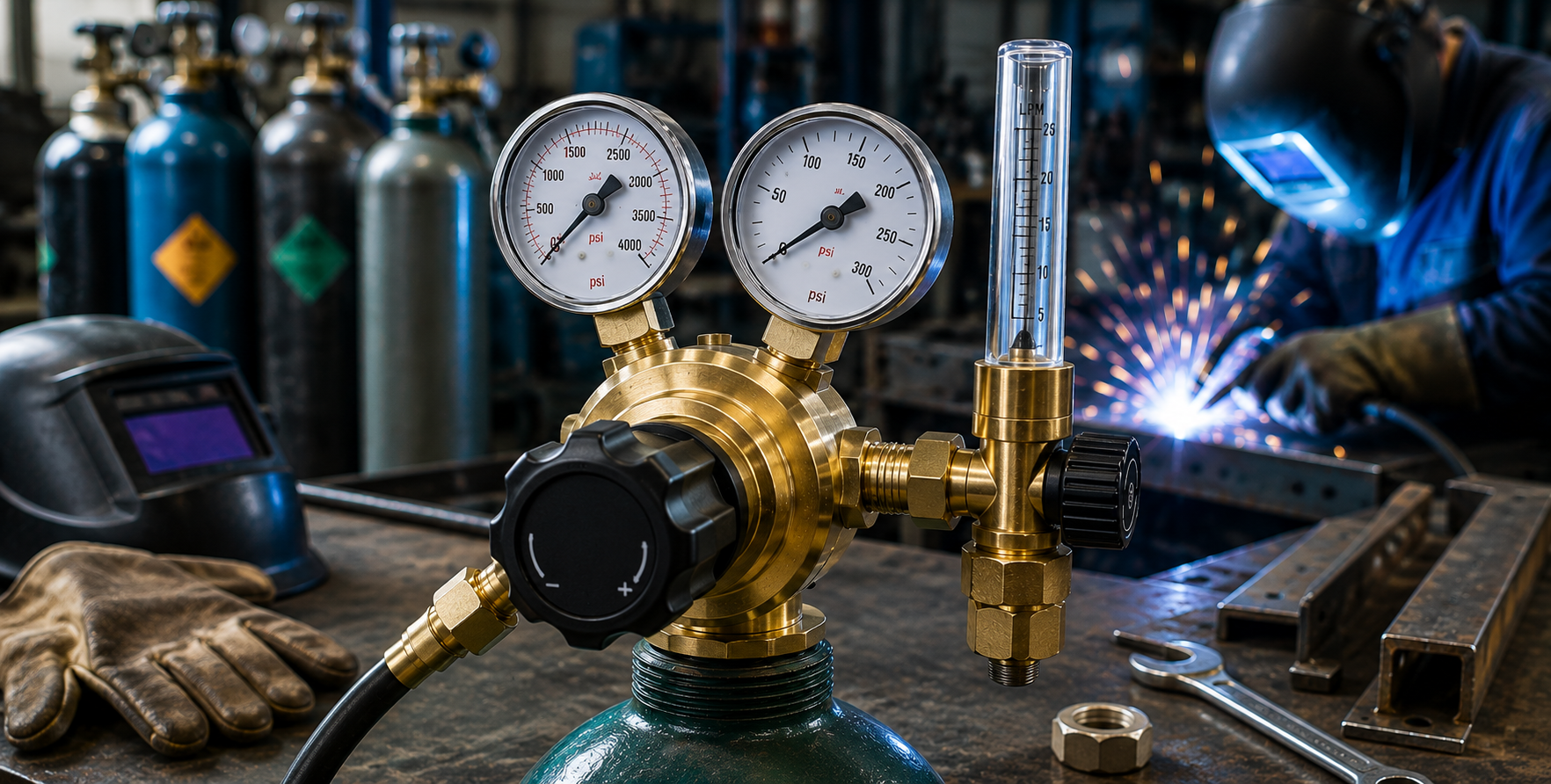
Choosing the wrong welding regulator can lead to gas-flow problems, connection issues, unnecessary gas consumption, and equipment compatibility concerns. Whether you use oxygen, argon, acetylene, CO2, or another welding gas, selecting a regulator that matches your application is an important part of setting up a reliable welding system.
A welding regulator controls the pressure of gas coming from a cylinder before it reaches welding or cutting equipment. The right regulator helps provide controlled gas delivery and allows operators to monitor pressure or gas flow as required.
For fabrication workshops, construction companies, maintenance teams, contractors, and industrial businesses in Saudi Arabia, choosing the right welding gas regulator requires more than simply selecting a product that fits a gas cylinder. Gas type, pressure, flow rate, connections, regulator type, and application all need to be considered.
This guide explains the key factors to consider when choosing a welding regulator and provides a practical checklist for industrial buyers.
A welding regulator is a device connected to a gas cylinder that reduces and controls the pressure of the gas before it is supplied to welding or cutting equipment.
Gas cylinders can contain gas at high pressure, while welding equipment generally requires gas at a controlled working pressure. The regulator reduces the cylinder pressure to a suitable level for the application.
Depending on the design, a regulator may include pressure gauges, adjustment controls, or a flowmeter. These features allow operators to monitor and control gas delivery during use.
Welding regulators are commonly used with gases such as:
Oxygen
Acetylene
Argon
CO2
Nitrogen
Mixed shielding gases
Because different gases can have different operating and compatibility requirements, the regulator should always be selected according to the gas manufacturer's and regulator manufacturer's specifications.
The regulator is an important part of a gas delivery system. Selecting a suitable product can help operators maintain better control over gas pressure and flow.
For industrial welding applications, the right regulator can provide:
Controlled gas pressure
Consistent gas delivery
Suitable shielding gas flow
Better equipment compatibility
Easier pressure monitoring
Reduced unnecessary gas consumption
Reliable operation
Better control during welding
For example, MIG and TIG welding often require controlled shielding gas flow. Gas welding and cutting applications may have different pressure and gas compatibility requirements.
This is why buyers should select a regulator based on the actual application rather than choosing a product only because it is inexpensive or looks similar to another model.
The first step is to determine which gas the regulator will be used with.
Common welding and industrial gases include:
Oxygen
Acetylene
Argon
CO2
Nitrogen
Mixed shielding gases
Different gases can require different regulator designs, materials, seals, connections, and operating conditions.
For example, an oxygen regulator for welding is intended for oxygen service, while an argon regulator is designed for argon applications. An acetylene regulator is designed for acetylene systems, while a CO2 regulator is used for CO2 applications where specified.
Do not assume that one regulator can be used for every gas. Always check the product markings and manufacturer's specifications to confirm compatibility.
This is especially important for businesses purchasing multiple types of welding equipment or gas regulators for industrial operations.
Pressure is another important factor when selecting a welding gas pressure regulator.
The regulator receives gas from the cylinder at a higher pressure and reduces it to a suitable pressure for the downstream equipment. The required pressure can vary depending on the gas, welding process, equipment, and application.
Before purchasing, check:
Maximum inlet pressure
Required outlet pressure
Adjustable pressure range
Equipment operating pressure
Cylinder pressure requirements
The regulator should operate within its specified pressure range. Using a regulator outside its intended operating conditions can create performance and safety concerns.
For this reason, always check the welding equipment manufacturer's instructions and the regulator's technical specifications before purchasing.
Gas flow is particularly important in MIG and TIG welding because shielding gas is used to protect the weld area from atmospheric contamination.
A regulator with a suitable flowmeter can help operators monitor gas delivery. The required gas flow depends on factors such as:
Welding process
Material being welded
Shielding gas
Torch or nozzle design
Welding environment
Equipment settings
Using insufficient shielding gas may affect the welding process, while excessive gas flow can result in unnecessary gas consumption.
The goal is to use a regulator and flowmeter that provide a suitable range for the welding equipment and application.
If you are unsure about the required flow range, check the welding equipment manufacturer's recommendations before purchasing.
Connection compatibility is one of the most important things to check when buying a welding regulator.
The regulator needs to connect correctly to the gas cylinder and the downstream equipment. Different gas cylinders and equipment can use different connection types.
Before ordering, check:
Cylinder valve connection
Regulator inlet connection
Outlet connection
Hose connection
Thread type
Gas compatibility
Do not select a regulator simply because the connection appears to fit. Similar-looking fittings can have different specifications.
If you are unsure, provide the supplier with your cylinder details, gas type, equipment information, and application. This can help identify the appropriate connection.
Different types of regulators are available for different applications.
1. Single-Stage Regulators
A single-stage regulator reduces cylinder pressure through one main pressure-reduction stage. These regulators can be suitable for many general applications where the pressure requirements are straightforward.
2. Two-Stage Regulators
A two-stage regulator reduces pressure through two stages. This type can provide more stable outlet pressure as cylinder pressure changes and may be suitable for applications requiring consistent pressure control.
3. Flowmeter Regulators
A flowmeter regulator combines pressure regulation with gas-flow measurement. These products are commonly considered for shielding gas applications where the operator needs to monitor gas flow.
4. Gas-Specific Regulators
Some regulators are designed or specified for particular gases. These products should only be used with the gas and operating conditions specified by the manufacturer.
When selecting a regulator type, consider the gas, welding process, pressure requirements, flow requirements, and equipment specifications.
6. Check Pressure Gauges and Flowmeters
Pressure gauges and flowmeters provide useful information during welding operations.
Depending on the regulator design, a pressure gauge may show cylinder pressure or regulated outlet pressure. A flowmeter indicates the rate at which gas is being delivered.
When selecting a regulator, consider whether you need:
Cylinder pressure monitoring
Outlet pressure monitoring
Gas-flow monitoring
Adjustable gas flow
Easy-to-read gauges
Gauges should be suitable for the regulator's pressure range and easy for the operator to read.
If a gauge is damaged, difficult to read, or showing unusual readings, the equipment should be inspected according to the manufacturer's instructions.
Welding regulators used in industrial environments may be exposed to dust, moisture, vibration, frequent handling, and long working hours.
For this reason, buyers should consider the overall construction of the regulator.
Important factors include:
Durable body construction
Quality valves
Reliable seals
Materials suitable for the gas
Corrosion resistance where required
Secure connections
Ease of inspection and maintenance
Price is an important consideration for many businesses, but it should not be the only factor.
A suitable industrial welding regulator should meet the required specifications and be appropriate for the intended working environment.
Gas cylinders and welding gases require careful handling. Safety should therefore be considered when selecting and using a regulator.
Depending on the product design, useful features may include:
Pressure relief mechanisms
Clear pressure gauges
Reliable adjustment controls
Secure connections
Proper sealing
Gas-specific construction
Suitable shut-off arrangements
Operators should always follow the manufacturer's instructions for installation, operation, inspection, and maintenance.
Never modify a regulator or use it outside its specified application.
Different welding processes have different requirements. The following table provides general guidance:
| Application | Important Considerations |
|---|---|
| MIG Welding | Shielding gas compatibility, suitable flow range, flowmeter, connection type |
| TIG Welding | Controlled shielding gas flow, gas compatibility, suitable regulator and flowmeter |
| Stick Welding | A gas regulator is generally not required for the welding process itself, depending on the setup |
| Gas Welding | Correct fuel and oxygen compatibility, pressure range, connections |
| Gas Cutting | Gas type, pressure requirements, torch and equipment compatibility |
| Industrial Fabrication | Durability, reliability, pressure and flow requirements |
| Maintenance & Repair. | Application requirements, portability, gas compatibility, connections |
These are general considerations. The exact regulator should always be selected according to the manufacturer's specifications for the equipment and gas being used.
Before purchasing a welding regulator, use this quick checklist:
Gas type: What gas will the regulator be used with?
Inlet pressure: What pressure comes from the cylinder?
Outlet pressure: What pressure does the equipment require?
Flow rate: What gas-flow range is required?
Cylinder connection: Does the regulator match the cylinder valve?
Equipment connection: Is the outlet compatible with the hose or equipment?
Regulator type: Is a single-stage, two-stage, or flowmeter regulator required?
Gauges: What pressure information needs to be monitored?
Build quality: Is the regulator suitable for the working environment?
Specifications: Does the product meet the manufacturer's requirements?
If you are purchasing regulators in large quantities for a workshop, fabrication facility, or industrial project, reviewing these points before ordering can help reduce compatibility problems.
The cheapest product may not have the pressure range, flow control, connection, or construction required for your application.
Compare the complete specifications before making a purchase.
Always confirm that the regulator is suitable for the gas being used. Never assume that a regulator designed for one gas is automatically suitable for another.
A regulator must be appropriate for the required inlet and outlet pressures. Check the equipment specifications before purchasing.
Always verify the cylinder and equipment connections. This is especially important when purchasing regulators for multiple gas types.
For MIG and TIG applications, make sure the regulator or flowmeter can provide the required gas-flow range.
Do not rely only on product images or general descriptions. Check technical specifications before purchasing.
Industrial businesses should choose a supplier that can provide clear product information and help customers identify suitable welding equipment and accessories.
Regular inspection and proper handling are important for gas-control equipment.
Basic maintenance practices include:
Inspect the regulator before use.
Check gauges for visible damage.
Check connections for signs of leakage.
Keep the regulator clean and dry.
Avoid dropping or striking the regulator.
Protect connections when the equipment is not being used.
Store the regulator according to manufacturer recommendations.
Do not make unauthorized modifications.
Replace damaged components as recommended.
Follow the manufacturer's inspection and maintenance instructions.
If you notice gas leakage, unstable pressure, damaged gauges, corrosion, or other unusual conditions, stop using the equipment and follow the appropriate inspection or replacement procedure.
A regulator may require inspection, servicing, or replacement if it develops visible or operational problems.
Some warning signs include:
Damaged pressure gauges
Gas leakage
Unstable pressure
Damaged threads
Loose connections
Corrosion
Damaged valves
Physical impact damage
Difficulty adjusting pressure
Damaged gas-control equipment should not be used simply because it still appears to operate. Follow the manufacturer's recommendations and applicable workplace procedures.
Finding a reliable welding equipment supplier in Saudi Arabia is an important part of purchasing the right industrial products.
Businesses should look for a supplier that can provide suitable welding regulators based on the gas type, welding process, pressure requirements, flow requirements, and equipment connections.
KASWELD supplies welding equipment, welding accessories, safety products, abrasives, tools, and other industrial supplies for customers in Saudi Arabia.
Businesses looking for a welding regulator supplier in Saudi Arabia can contact KASWELD with their application requirements. Providing information such as gas type, welding process, pressure range, flow requirements, cylinder connection, and equipment details can help identify a suitable product.
KASWELD supports customers looking for industrial products for workshops, fabrication operations, construction projects, maintenance work, and other professional applications.
Whether you need an oxygen regulator for welding, argon regulator, acetylene regulator, CO2 regulator, or another specified gas regulator, always confirm that the product is suitable for the intended gas and application before use.
1. What is a welding regulator?
A welding regulator is a device that reduces and controls gas pressure from a cylinder before supplying gas to welding or related equipment. Depending on the design, it may include pressure gauges or a flowmeter to monitor gas pressure and flow.
2. How do I choose the right welding gas regulator?
Start by identifying the gas type. Then check the required pressure range, gas flow rate, cylinder connection, equipment connection, regulator type, gauge requirements, and manufacturer's specifications.
3. Can one regulator be used for different gases?
Not necessarily. Regulators are designed or specified for particular gases and operating conditions. Always check the manufacturer's specifications to confirm whether a regulator is suitable for the intended gas.
4. What is the difference between a regulator and a flowmeter?
A regulator primarily reduces and controls gas pressure, while a flowmeter measures or helps control gas flow. Some welding products combine both functions in one unit.
5. Why is gas compatibility important?
Gas compatibility is important because regulators can be designed with specific materials, seals, connections, and operating requirements for particular gases. Using equipment that is not suitable for a gas can create operating and safety concerns.
6. How often should a welding regulator be inspected?
Inspection requirements vary depending on the regulator, manufacturer instructions, application, and workplace procedures. Operators should inspect equipment before use and follow the manufacturer's recommended inspection and maintenance schedule.
7. Where can I buy welding regulators in Saudi Arabia?
Welding regulators are available from industrial and welding equipment suppliers in Saudi Arabia. KASWELD supplies welding regulators, welding equipment, accessories, safety products, and other industrial supplies for professional applications.
Choosing the right welding regulator requires more than selecting a product that fits a gas cylinder. Buyers should consider the gas type, pressure range, gas flow, cylinder connection, equipment compatibility, regulator type, gauges, build quality, and safety features before purchasing.
For MIG and TIG welding, controlled shielding gas flow is particularly important. For gas welding and cutting, gas compatibility, pressure requirements, and connections are key considerations. Industrial fabrication and maintenance teams should also consider product durability and suitability for their working environment.
Before purchasing, always check the manufacturer's specifications and confirm that the regulator is designed for the intended gas and application.
If you are looking for welding regulators, welding equipment, and industrial welding supplies in Saudi Arabia, contact KASWELD with your gas type, welding process, pressure requirements, and equipment details to find a suitable product for your application.