Welcome to Khalid Nehar Al Shamry Trading Est. |
[email protected]






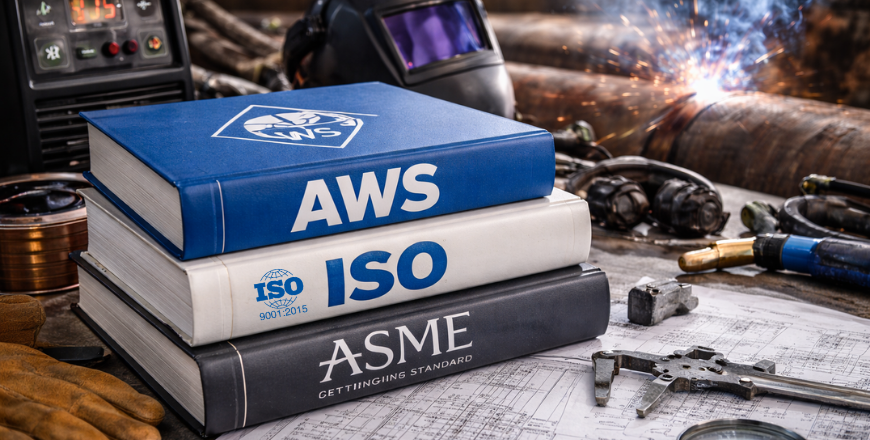
Welding is used in many industries, such as oil and gas, construction, and manufacturing. To make sure welding is safe and strong, companies follow specific rules. These rules are called welding standards.
Welding standards help ensure that every weld is done correctly. They improve safety, quality, and performance. In this blog, you will learn about the most important welding standards: AWS, ISO, and ASME.
Welding standards are important for many reasons.
They help to:
Ensure safety in projects
Maintain consistent quality
Reduce welding defects
Meet legal and industry requirements
Improve trust with clients
Without proper standards, welding work can become unsafe and unreliable.
The American Welding Society (AWS) is one of the most well-known organizations for welding standards.
AWS provides guidelines for:
Welding procedures
Welder qualification
Inspection and testing
Welding symbols and codes
AWS standards are widely used in construction and industrial projects.
The International Organization for Standardization (ISO) creates global standards used worldwide.
ISO welding standards focus on:
Quality management
Welding processes
Certification systems
International compatibility
ISO standards are important for companies working in international markets.
The American Society of Mechanical Engineers (ASME) sets standards mainly for pressure equipment.
ASME standards are used in:
Boilers
Pressure vessels
Pipelines
Oil and gas projects
The most important standard is ASME Section IX, which covers welding and brazing qualifications.
ASME standards are critical for high-pressure and high-temperature applications.
Here is a simple comparison:
AWS – Focus on welding techniques and construction work
ISO – Global standards for quality and certification
ASME – Focus on pressure systems and heavy industries
Each standard has a different purpose, but all aim to improve safety and quality.
Choosing the right standard depends on your project.
For construction → AWS
For international projects → ISO
For oil & gas and pressure systems → ASME
Many projects use a combination of these standards.
Following welding standards is not optional. It is required in most industries.
Benefits of compliance:
Avoid legal issues
Improve project safety
Increase customer trust
Ensure long-term performance
Companies that follow standards are more reliable and professional.
Using proper welding standards can:
Reduce repair costs
Improve product quality
Increase efficiency
Help win more projects
Clients prefer companies that follow international standards.
1. What are welding standards?
Welding standards are rules that guide how welding should be done safely and correctly.
2. Why are AWS, ISO, and ASME important?
They ensure welding quality, safety, and global acceptance.
3. Which welding standard is best?
It depends on your project. Many industries use a combination of AWS, ISO, and ASME.
Welding standards like AWS, ISO, and ASME are essential for safe and high-quality work. They provide clear guidelines for procedures, materials, and inspection.
By following these standards, companies can improve safety, reduce risks, and deliver reliable results.
Looking for reliable welding equipment and safety products?
? Contact us today for trusted solutions and fast delivery.