Welcome to Khalid Nehar Al Shamry Trading Est. |
[email protected]







Choosing the right welding machine is one of the most important decisions for any welding project. Whether you are a beginner, DIY enthusiast, professional fabricator, contractor, or industrial manufacturer, the welding machine you use directly affects the quality, strength, and efficiency of your work. With so many options available in the market, finding the perfect machine can seem challenging. Understanding your project requirements, materials, and welding process will help you make the right choice.
This guide explains everything you need to know about selecting the best welding machine for your project, helping you invest in equipment that delivers reliable performance and long-term value.
The first step in choosing a welding machine is understanding the type of work you plan to do. Different projects require different welding processes and machine capabilities.
Consider the following questions before purchasing a welding machine:
What type of metal will you be welding?
How thick is the material?
Will you work indoors or outdoors?
Is the machine for occasional home use or daily industrial work?
Do you need a portable welding machine?
For example, if you are repairing gates, grills, or metal furniture, a MIG welding machine is an excellent option. If your work involves stainless steel kitchen equipment or aluminium fabrication, a TIG welding machine provides better precision. Construction companies and maintenance professionals often choose Stick welding machines because they perform well in outdoor conditions.
Understanding your application helps narrow your choices and prevents unnecessary spending.
1. MIG Welding Machine
MIG (Metal Inert Gas) welding is one of the most popular welding methods because it is easy to learn and offers high productivity. It uses a continuously fed wire electrode and shielding gas to create clean, strong welds.
MIG welders are ideal for automotive repairs, fabrication shops, home improvement projects, and light industrial work. They are suitable for welding mild steel, stainless steel, and aluminum with the proper wire and accessories.
The biggest advantages of MIG welding are faster welding speed, minimal slag, clean finishes, and easy operation, making it a great choice for beginners.
TIG (Tungsten Inert Gas) welding is known for producing the highest-quality welds with exceptional precision. It is commonly used for stainless steel, aluminum, and other non-ferrous metals where appearance and strength are critical.
Industries such as aerospace, food processing, pharmaceutical manufacturing, and custom fabrication rely on TIG welding because it creates neat, clean welds with minimal spatter.
Although TIG welding requires more skill and patience, it delivers professional-quality results.
3. Stick Welding Machine
Stick welding, also called Shielded Metal Arc Welding (SMAW), is widely used for construction, pipeline work, heavy fabrication, and equipment maintenance.
Unlike MIG welding, Stick welding does not require shielding gas, making it suitable for outdoor work where wind can affect gas coverage.
Stick welders are durable, affordable, and capable of welding rusty or dirty metal surfaces. However, they produce more slag, which requires cleaning after welding.
4. Multi-Process Welding Machine
A multi-process welding machine combines MIG, TIG, and Stick welding capabilities in one unit.
These machines are perfect for fabrication workshops and professionals who work on different types of projects. Instead of purchasing multiple machines, users can switch between welding processes depending on the material and application.
Although multi-process machines have a higher initial cost, they offer excellent flexibility and long-term savings.
The type of metal you weld plays a significant role in selecting the right welding machine.
Mild steel is commonly welded using MIG or Stick welding machines. Stainless steel can be welded using both MIG and TIG welders, although TIG produces cleaner and more attractive welds. Aluminum requires either a TIG welder or a MIG machine equipped with a spool gun for consistent wire feeding. Cast iron repairs are usually completed using Stick welding.
Choosing the appropriate welding process ensures better weld strength, improved appearance, and reduced chances of defects.
1. Consider Material Thickness
Material thickness determines the power output your welding machine should provide.
Thin sheet metal requires lower amperage to prevent burn-through, while thicker steel plates require higher amperage for proper penetration.
For general fabrication work, a welding machine with an output of 200 to 250 amps is suitable for most applications. If you regularly weld heavy structural steel, consider machines with higher amperage and greater duty cycles.
Buying a slightly more powerful machine than your current needs also prepares you for future projects.
2. Select the Right Power Supply
Before purchasing a welding machine, make sure it is compatible with your available power supply.
Portable welding machines designed for home use often operate on standard single-phase power. Professional fabrication workshops usually prefer 220V machines because they deliver greater welding capacity.
Large manufacturing plants and heavy industries commonly use three-phase welding machines, which provide continuous power for demanding applications.
Matching the welding machine with your electrical supply ensures safe and efficient operation.
3. Understand Duty Cycle
Duty cycle is an important specification that many buyers overlook.
It indicates how long a welding machine can operate continuously within a ten-minute period before requiring cooling.
For example, a machine with a 60% duty cycle at 200 amps can weld continuously for six minutes before needing four minutes to cool.
A higher duty cycle is essential for industrial users who perform continuous welding throughout the day. For occasional repairs and hobby projects, a lower duty cycle is generally sufficient.
Inverter welders consume less electricity, are easy to transport, and offer better control during welding. These advantages make them suitable for both professionals and beginners.
Transformer welding machines, on the other hand, are heavier and less portable but are known for their durability in demanding industrial environments.
For most users, inverter welding machines offer the best combination of performance, efficiency, and portability.
Today's welding machines include advanced features that improve both safety and performance.
Some useful features include digital displays for accurate settings, Hot Start for easier arc ignition, Arc Force for improved arc stability, Anti-Stick technology to prevent electrode sticking, overload protection, thermal protection, and voltage fluctuation protection.
These features simplify operation and help produce cleaner, stronger welds.
Investing in a trusted welding machine brand ensures better performance, reliable after-sales service, and easy availability of spare parts.
Well-known manufacturers such as ESAB, Lincoln Electric, Miller, Fronius, Kemppi, Panasonic, Hyundai Welding, Jasic, and Riland have built strong reputations for quality and durability.
Always purchase from an authorized supplier to ensure you receive genuine products backed by warranty support.
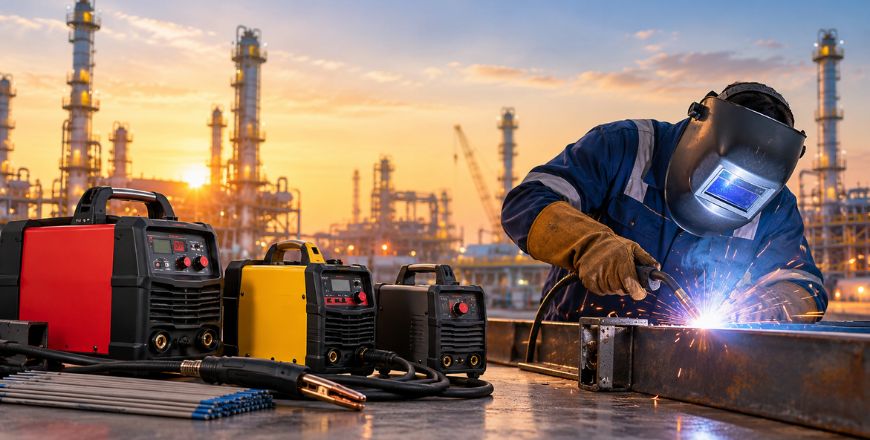
You should also invest in quality accessories such as a welding helmet, welding gloves, welding cables, earth clamp, electrode holder, gas regulator, welding torch, safety shoes, protective clothing, wire brush, and chipping hammer.
Using high-quality accessories improves safety, comfort, and welding performance while reducing the risk of workplace injuries.
Many buyers focus only on the purchase price without considering long-term performance.
Avoid choosing a machine with insufficient amperage, ignoring duty cycle ratings, purchasing from unknown brands, or selecting a welding process that does not match your application.
It is also important to consider future projects. Buying a slightly more capable machine today can save you from replacing it later as your work grows.
1. Proper maintenance extends the life of your welding machine and ensures consistent performance.
2. Keep the machine clean by removing dust regularly, inspect cables and connectors before each use, maintain proper ventilation around the machine, and store it in a dry environment to prevent moisture damage.
3. Replace worn consumables promptly and schedule periodic servicing to reduce downtime and improve reliability.
Frequently Asked Questions
1. Which welding machine is best for beginners?
A MIG welding machine is generally the best choice because it is easy to operate, produces clean welds, and requires minimal training.
2. Which welding machine is best for stainless steel?
TIG welding machines provide the highest-quality stainless steel welds, although MIG welding is also suitable for production work.
3. Can one welding machine perform multiple welding processes?
Yes. Multi-process welding machines support MIG, TIG, and Stick welding, making them ideal for workshops that handle different types of projects.
4. How many amps do I need?
For most fabrication work, a machine with an output of 200 to 250 amps is sufficient. Heavy industrial applications may require higher amperage.
5. Is an inverter welding machine better than a transformer machine?
For most users, inverter welding machines are the better option because they are lightweight, energy-efficient, portable, and provide smoother arc performance.
Choosing the right welding machine is an investment that directly impacts the quality and success of your projects. By understanding your welding requirements, selecting the appropriate welding process, considering material type and thickness, evaluating duty cycle, and choosing a reliable brand, you can confidently purchase equipment that meets your needs.
Whether you are working on home repairs, automotive fabrication, construction projects, or industrial manufacturing, the right welding machine will improve productivity, deliver stronger welds, and reduce operating costs. Pair your machine with quality welding accessories and follow regular maintenance practices to ensure reliable performance for years to come.
By making an informed decision today, you can enjoy safer, more efficient, and professional welding results on every project.